

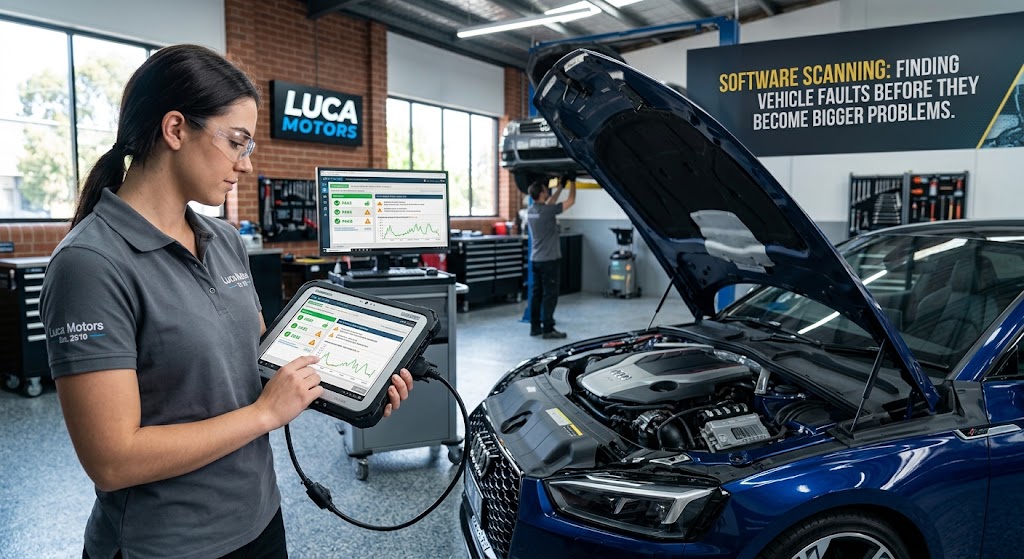
Software scanning allows a technician to read information stored in those systems. Luca Motors offers ECU diagnostics and software scanning in Alphington to help investigate warning lights, performance concerns and intermittent faults.
The key point: a scan provides evidence. The results still need to be interpreted alongside your symptoms, physical checks and any further tests needed to identify the cause.
What is software scanning?
A technician connects suitable diagnostic equipment to the vehicle’s diagnostic connector. The equipment communicates with supported control units and retrieves information such as diagnostic trouble codes and live operating data.
The information available depends on the vehicle and the equipment. Relevant systems may include engine management, automatic transmission, braking electronics, airbags, stability control, steering, battery management and climate control.
Scanning is different from installing a software update or reprogramming a control unit. Those are separate procedures that are considered only when appropriate for the vehicle and fault.
When is a diagnostic scan useful?
Book an assessment when a warning appears or the vehicle behaves differently. Useful examples include:
- A check-engine, ABS, airbag or transmission warning.
- Hesitation, reduced power or an unexpected change in acceleration.
- Rough idling, misfiring or difficult starting.
- A noticeable increase in fuel consumption.
- A fault that comes and goes, even if the car seems normal at the appointment.
These symptoms do not all have electronic causes. A scan can help direct the investigation, but a battery problem, air leak or worn mechanical component may also need separate testing.
Follow the vehicle handbook for warning-light instructions. If a warning is accompanied by severe shaking, overheating, loss of braking or an oil-pressure alert, stop safely and seek advice before continuing to drive.
What happens during software scanning?
First, describe the problem
Tell the workshop when the symptom began and the conditions in which it occurs. A problem that happens only after a cold start may need a different approach from one that appears on a long drive. Recent repairs, a flat battery or the timing of a warning can also be useful context.
Read and interpret stored information
The technician can review relevant fault codes and, where available, data recorded when a fault was detected. The status of a code matters: a historical record may need to be interpreted differently from a fault that is currently present.
Check live data and carry out further tests
Live data may show readings such as engine temperature, airflow, voltage or fuel pressure, depending on the system. Comparing readings with expected values can help narrow the investigation.
Electrical checks, leak testing, component tests or a safe road test may then be required. A code referring to a sensor circuit, for example, could involve the sensor, wiring, a connector or another condition affecting the reading.
How does it compare with a basic code reader?
A basic reader can be useful for retrieving some codes. Its limitation is usually the range of systems and information it can access, rather than a guarantee that every code it displays is inaccurate.
Professional equipment may provide broader vehicle coverage, manufacturer-specific information and additional testing functions. The technician’s interpretation remains essential with either type of tool. Our guide to ECU diagnostics explains why a code alone is not a repair recommendation.
Can scanning find intermittent or hidden faults?
Sometimes. Stored data may remain after a warning disappears, giving the workshop a starting point when the symptom cannot be reproduced. However, not every problem stores a code, and clearing codes before an appointment may remove useful information.
A scan may also be useful during a used-car inspection, but it cannot replace a physical examination or confirm that the vehicle is free of faults.
Can early diagnosis reduce repair costs?
Investigating a fault before replacing parts can reduce the risk of paying for a repair that does not address the cause. Early attention can also help prevent some problems from worsening.
It cannot guarantee a low-cost repair or prevent every breakdown. Diagnostic time varies with the problem, especially where further testing or an intermittent symptom is involved.
Software scanning at Luca Motors
European vehicles and other modern cars can have model-specific diagnostic requirements. Provide your make, model, year and symptoms so we can discuss a suitable starting point.
Call 03 9499 6203 to enquire about diagnostics at 164 Grange Road, Alphington VIC 3078. The aim is to explain what the evidence shows and what testing or repair should follow.