

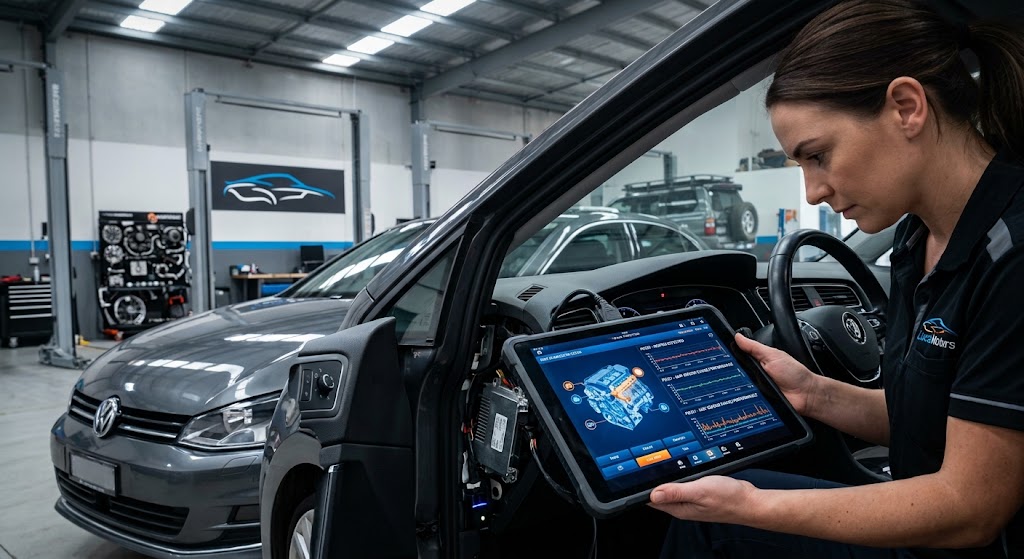
When a check-engine light appears, it is natural to want a quick answer. The light tells you that the vehicle has detected a problem, but it does not identify the cause on its own. Several faults can produce similar symptoms.
ECU diagnostics helps a technician investigate the information recorded by the vehicle’s control systems. At Luca Motors in Alphington, ECU diagnostics and software scanning forms part of the process of assessing warning lights, electronic faults and changes in engine performance.
A useful distinction: reading a fault code and diagnosing a fault are separate steps. A code points the investigation towards a system or condition; testing helps establish what has caused it.
What does an ECU do?
ECU is commonly used to mean electronic control unit. In an engine-management context, it may refer to the engine control unit. Modern vehicles can have several control units responsible for different functions.
The engine controller uses information from sensors to manage functions such as fuel delivery and ignition, where applicable. Other modules may manage the transmission, braking electronics or body systems. A problem can involve a component, its electrical supply or communication between systems.
Diagnostic equipment lets the technician access supported modules and examine the information available for that vehicle.
When should you book ECU diagnostics?
A diagnostic appointment may be appropriate if you notice:
- A check-engine light or another persistent dashboard warning.
- Difficult starting, stalling or an uneven idle.
- Poor throttle response, hesitation or loss of power.
- Unexpected changes in fuel consumption.
- Electrical symptoms that appear intermittently.
- A reduced-power or limp-mode message.
These signs overlap with mechanical, ignition, air-intake and fuel-system problems. For example, our guide to fuel system diagnostics explains why poor acceleration does not automatically mean a fuel pump or injector needs replacing.
What happens during the diagnostic process?
Understanding the symptoms
Your description matters. Note whether the issue occurs with a cold or warm engine, while idling or accelerating, or after a particular event. Mention recent repairs, battery problems and any attempts to clear the warning.
If you have a photo of the dashboard message, bring it along. Record details only when safely parked; there is no need to recreate a potentially unsafe fault.
Scanning the relevant systems
The technician connects compatible diagnostic equipment and checks relevant fault records. Depending on the vehicle, the scan may also show live sensor readings and information recorded when a fault occurred.
A record of a past event can be helpful even when the dashboard warning has disappeared. However, a scan without stored codes does not rule out every possible mechanical or electrical problem.
Testing possible causes
The next steps depend on the findings. They may involve checking wiring, connectors, power supplies, sensor readings or mechanical operation. Manufacturer-specific procedures can help determine which tests are appropriate.
Software-related issues may also be considered, but a software update is not automatically included in a scan or required every time a warning appears.
Can diagnostics identify a faulty sensor?
It can help, but a sensor-related code is not sufficient evidence by itself. An unusual reading could come from a failed sensor, damaged wiring, a poor connection or an actual condition the sensor is correctly reporting.
Replacing the named sensor without checking the surrounding system can leave the original fault unresolved. Comparing readings and performing targeted tests provides a stronger basis for a repair recommendation.
What if the vehicle has entered limp mode?
Reduced-power operation can limit performance after the vehicle detects certain faults. The meaning and recommended response vary by model and warning message, so follow the instructions in the owner’s handbook.
Do not assume reduced-power mode makes the vehicle safe for a normal journey. If you cannot maintain safe control, or there is severe shaking, overheating, smoke or an urgent oil-pressure warning, stop safely and arrange assistance. Speak with the workshop before driving a vehicle whose condition is uncertain.
What happens after the scan?
The useful outcome is an explanation of the findings and the next step. That may be a supported repair recommendation, a request for further testing or a plan to investigate an intermittent symptom.
Clearing a code can be part of checking a completed repair, but removing a dashboard warning alone does not fix the cause. A fault can return if the underlying problem remains.
Book ECU diagnostics in Alphington
Luca Motors provides diagnostic and mechanical services for everyday vehicles, European cars and 4x4s. Tell us your vehicle details when booking so we can discuss the issue and suitable testing.
Call 03 9499 6203 or enquire about our ECU diagnostic service at 164 Grange Road, Alphington VIC 3078. Early investigation helps you understand the problem and make an informed decision about the work required.