

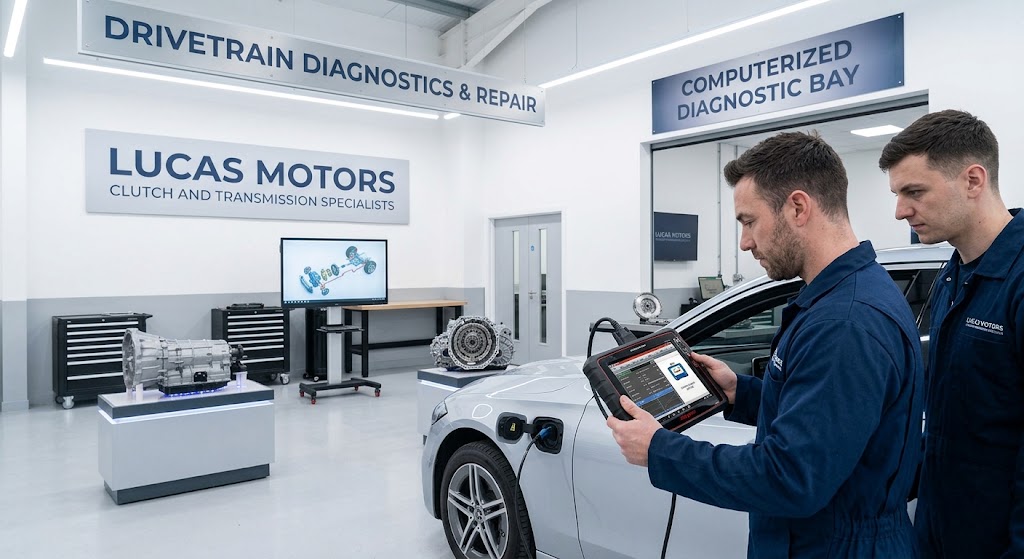
At a glance: A scan tool retrieves information from a vehicle’s electronic systems through its diagnostic connector. The readings guide testing; they are not a confirmed diagnosis or a list of parts to replace.
When a dashboard warning appears, your vehicle may have stored information about what happened. A diagnostic scan can retrieve that information and help a technician decide which checks to carry out next.
At Luca Motors in Alphington, scan tool diagnostics forms part of a wider fault-finding process. The useful result is an explanation supported by the vehicle’s symptoms and test results, rather than simply a printout of fault codes.
What are scan tool diagnostics?
A diagnostic scan tool connects to the vehicle’s diagnostic connector, commonly called the OBD port. This is a dedicated vehicle connector, not the USB socket used for a phone or entertainment system.
Depending on the vehicle and equipment, a scan can retrieve diagnostic trouble codes, show live operating data and display information stored when a fault was detected. Different tools and vehicle systems provide different levels of access.
Relevant systems may include engine management, the transmission, ABS, airbags, stability control, climate control and electronic steering. Access to one system does not mean every other module or function is supported.
What a fault code actually means
A code generally identifies a condition detected by a control unit. It may relate to a circuit, a signal outside the expected range or system performance. Several different causes can produce the same code.
For example, a sensor reading can be affected by wiring, its power supply or the mechanical condition it is measuring. Replacing that sensor without supporting tests may leave the fault unresolved.
Some stored codes also relate to an earlier event rather than the current complaint. The technician needs to consider when the code occurred, whether it is active and how it fits with the symptoms.
When should you arrange a diagnostic assessment?
Dashboard warnings
An engine, transmission, ABS or airbag warning needs advice appropriate to the system. A vehicle may feel normal while a monitored function has a fault. The owner’s manual explains the meaning and immediate response for particular warnings.
Changes in starting or running
Difficult starting, rough idling, hesitation and reduced power can involve electronic or mechanical causes. Live data and stored information can help narrow the investigation, but additional testing may be needed.
Unexpected fuel consumption
A sustained increase in fuel use under comparable driving conditions can be worth investigating. Tell the workshop about changed trips, loads or traffic as well as any warning lights. Fuel consumption and engine-oil consumption are separate observations and should be described separately.
Intermittent symptoms
A fault that appears only when hot, in wet conditions or after a long drive may be difficult to reproduce. A clear record of when it happens can be as useful as a scan result. Avoid clearing codes before the appointment because stored details may help.
How the diagnostic process works
- Understand the complaint. The technician reviews symptoms, recent repairs and service history.
- Check relevant conditions. Initial physical checks and battery condition may need attention before electronic readings are interpreted.
- Connect and scan. A suitable tool connects to the diagnostic port and retrieves information from the relevant modules.
- Review the evidence. Codes, recorded conditions and live data are compared with expected operation and the reported symptom.
- Carry out supporting tests. These may involve electrical measurements, component operation or mechanical checks.
- Discuss the findings. The next step may be an agreed repair or further investigation where the cause remains uncertain.
After repairs, appropriate checks can assess whether the original concern has been addressed. The required process depends on the vehicle and fault.
Professional diagnostics and basic code readers
A basic reader can be useful for retrieving some fault information. It may have limited access to manufacturer-specific codes, non-engine modules or live data. A more capable scan tool can offer additional information and supported test functions.
Equipment capability alone is not the diagnosis. Choosing a test, interpreting its result and checking mechanical causes still require knowledge of the vehicle. Programming, calibration and software work also have their own requirements and should not be assumed to be part of every scan.
What diagnostics can and cannot find
Scan information can support investigation of misfires, fuel and airflow concerns, charging faults, transmission operation and electronic safety-system warnings. A scan does not necessarily identify the precise failed component in any of these cases.
It also cannot replace an inspection of worn brakes, damaged suspension or a mechanical leak. If a transmission concern is involved, our guide to clutch and transmission assessment explains the wider checks that may be needed.
Scan tool diagnostics FAQs
Does clearing a warning light fix the problem?
No. Clearing stored information does not repair a fault. The light may return when the system detects the condition again.
How often does my car need a scan?
There is no universal scanning interval. It may be appropriate for a reported symptom, a specific service procedure or another assessment. Routine maintenance remains necessary even when no codes are stored.
Can I keep driving with an engine warning?
The response depends on the warning and symptoms. If it flashes, the engine runs very roughly, the car overheats or control is affected, stop safely and seek advice before continuing.
How long will the assessment take?
Reading codes and confirming an intermittent fault are different tasks. Ask about the initial assessment and how any additional investigation will be discussed.
Book a diagnostic assessment in Alphington
Contact Luca Motors at 164 Grange Rd, Alphington VIC 3078, on 03 9499 6203 or send an enquiry. Include the vehicle details, warning message and circumstances in which the concern occurs.