

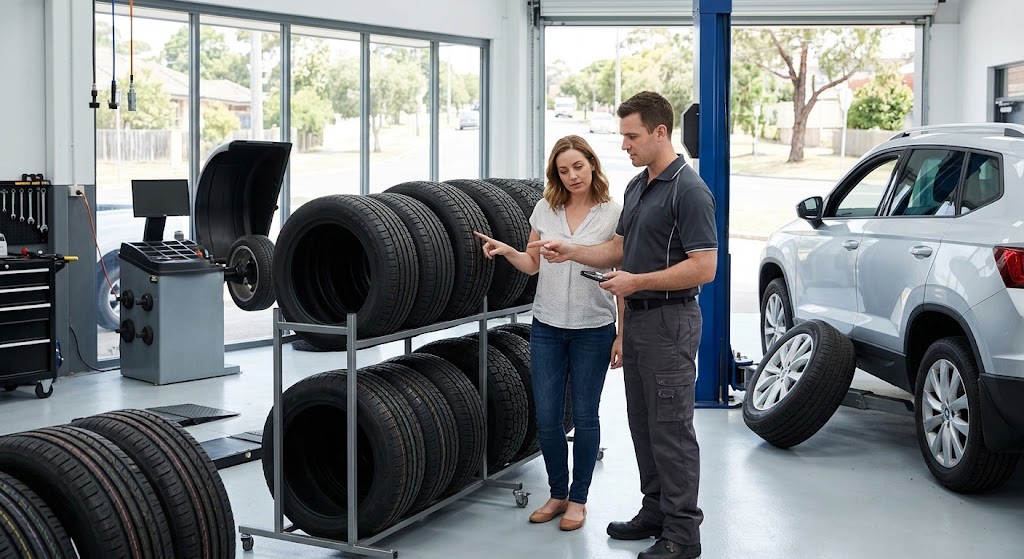
Choosing replacement tyres involves more than matching the size printed on the sidewall. The right tyre also needs to suit the vehicle’s load and speed requirements, wheel fitment and the way you use the car.
Luca Motors offers tyre supply, fitment and repair in Alphington. We can assess your current tyres and discuss suitable replacements for your vehicle and driving needs.
Start with the vehicle requirements: check the tyre placard and manufacturer information, then consider your usual driving. Do not assume the tyres already fitted are the correct specification.
Why tyre condition matters
Tyres provide the contact between your vehicle and the road. Their condition and pressure influence grip, braking, handling and comfort. Worn or damaged tyres can compromise those qualities, particularly when road conditions are poor.
A suitable tyre is a practical choice for the vehicle, rather than simply the cheapest or most expensive option. It should meet the required specifications and suit the load and conditions it will encounter.
How to choose the right replacement tyres
Confirm size and specifications
The vehicle’s tyre placard and handbook are the starting points for approved tyre sizes and pressures. Load and speed ratings matter too. Different wheel sizes or a modified vehicle may require additional checks before selecting a replacement.
Give the workshop your make, model, year and wheel details. A tyre’s appearance or nominal size alone does not establish that it is appropriate.
Consider your normal driving
Explain whether you mainly drive around Melbourne, cover long highway distances, tow, carry heavier loads or use unsealed roads. Passenger cars and 4x4s can have very different needs.
Wet-weather performance, road noise, comfort and expected wear are useful comparison points. Your budget belongs in the discussion, alongside suitability. Ask what trade-offs distinguish the available options.
When should tyres be inspected or replaced?
Have your tyres checked if you notice:
- Low or uneven tread wear.
- Cuts, cracking, bulges or other visible damage.
- Repeated pressure loss or recurring punctures.
- Vibration, pulling or a change in handling.
- Damage after a kerb strike or pothole impact.
Tyres age as well as wear, so there is no single mileage figure that determines replacement for every vehicle. Their condition, age, use and manufacturer guidance all matter. Do not wait for a tyre to become completely smooth before asking for advice.
A bulge, exposed internal material or significant sidewall damage needs urgent attention. Avoid driving on a seriously damaged or flat tyre and arrange assistance if a safe replacement is not available. RACV’s tyre safety guidance explains the warning signs to look for.
Can a punctured tyre be repaired?
Some punctures are repairable, but the position and extent of the damage matter. The tyre also needs assessment for internal damage, especially if it has been driven while underinflated or flat.
Sidewall damage is generally unsuitable for a standard puncture repair. A technician should inspect the tyre before recommending repair or replacement; a nail visible in the tread does not by itself establish that a repair is possible.
Why are my tyres wearing unevenly?
Incorrect pressures, wheel alignment and worn steering or suspension components can contribute to uneven wear. Wheel or tyre damage can also affect how the vehicle feels on the road.
Replacing the tyre without checking the cause may allow the same wear pattern to develop again. If one edge wears faster or one tyre differs noticeably from the others, ask for the relevant checks alongside replacement.
Fitment, balancing and alignment
Correct fitting includes attention to the wheel, valve, tyre orientation where relevant and inflation pressure. Wheel balancing helps address an uneven distribution of weight that can contribute to vibration.
Alignment is a separate check of wheel angles. It may be appropriate when there is uneven wear, pulling or related repair work. It does not fix every vibration, so the symptoms should guide the assessment.
Do all four tyres need replacing together?
That depends on their condition and the vehicle’s requirements. Some drivetrains are sensitive to differences in tyre size or rolling circumference, while other vehicles may permit replacement in suitable pairs.
Follow the manufacturer’s guidance and have the remaining tyres assessed. The decision should account for tread differences, matching specifications and the location of the replacements, rather than assuming a single tyre is always sufficient.
Helping your tyres last
Check pressures regularly using the manufacturer’s recommended cold settings, inspect for damage and have unusual wear investigated. Follow the vehicle’s guidance on rotation where applicable; not every tyre or wheel arrangement can be rotated in the same way.
For tyre supply or an inspection, call Luca Motors on 03 9499 6203. We are at 164 Grange Road, Alphington VIC 3078.