
At a glance: Repeated coolant loss or an overheating warning needs investigation. A coolant top-up does not repair a leak, and the correct coolant is determined by specification, not colour.
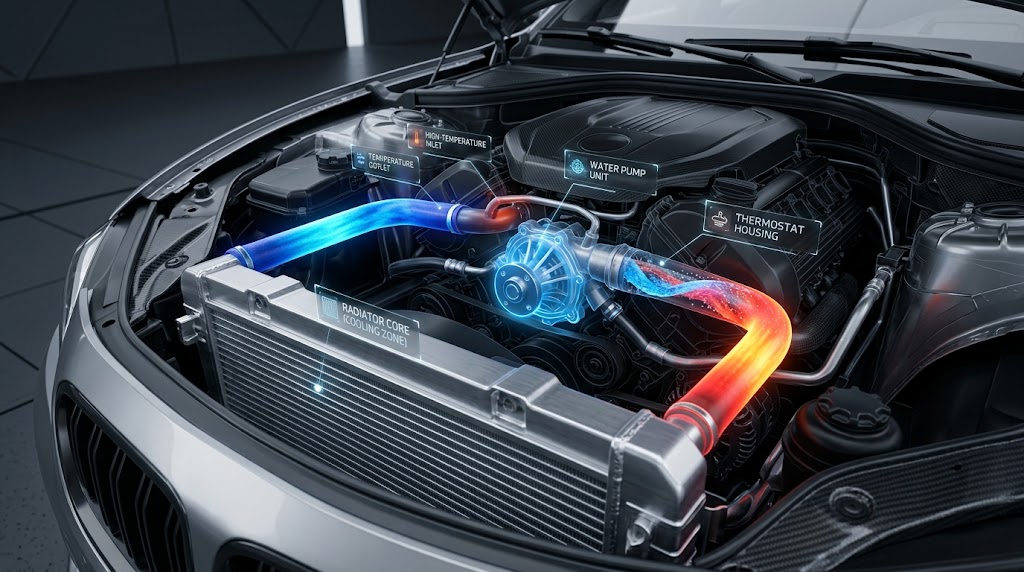
The engine cooling system carries heat away from the engine and releases it through the radiator. A loss of coolant or a fault affecting circulation or airflow can allow engine temperature to rise and cause serious damage.
Luca Motors provides cooling-system assessment, servicing and repair enquiries at our Alphington workshop. The work required depends on your vehicle, its service history and whether the concern is routine maintenance, a leak or overheating.
What does the cooling system do?
In a liquid-cooled engine, coolant circulates through the engine and radiator. The thermostat helps regulate that circulation, while airflow through the radiator allows heat to dissipate. Fans assist airflow when required.
Common components include:
- The radiator and pressure cap, with the cap location varying by design.
- Coolant meeting the manufacturer’s specification.
- The water pump and thermostat.
- Cooling fans and related electrical controls.
- Hoses, clamps, seals and the coolant reservoir.
- Temperature sensors and associated wiring.
A problem can involve a leak, restricted circulation, insufficient airflow or incorrect temperature information. Understanding which condition is present is more useful than replacing parts based on the temperature reading alone.
Signs your cooling system needs attention
Arrange advice if you notice any of the following:
- A temperature reading higher than usual or a coolant warning.
- Steam from under the bonnet.
- A visible leak or repeated drop in coolant level.
- An unusual sweet smell near the vehicle.
- A change in cabin-heater performance.
- Cooling fans behaving differently from normal.
- Discoloured coolant, visible contamination or deposits.
These observations do not identify the failed component by themselves. For example, heater performance can be affected by the cooling system or the cabin climate-control system. Describe the symptoms and the circumstances in which they occur.
What to do if the engine overheats
Stop in a safe place and switch off the engine. Do not remove a radiator or coolant reservoir cap while the system is hot: pressurised hot coolant can escape and cause burns.
Seek professional advice before continuing to drive. Waiting for the temperature to fall does not repair the cause of overheating, and repeatedly driving until the warning returns can lead to further damage.
Follow the owner’s manual for vehicle-specific instructions. If the car cannot be driven safely, arrange assistance rather than attempting to reach the workshop under its own power.
What may be included in a cooling-system service?
The scope depends on what is due and what the inspection finds. Relevant work may include:
- Checking coolant level and visible condition when safe.
- Inspecting the radiator, reservoir, hoses and connections.
- Looking for leaks and dried coolant residue.
- Pressure testing the system or cap when appropriate.
- Checking fan operation and relevant controls.
- Assessing thermostat and water-pump operation as required.
- Reviewing relevant fault codes and operating data.
- Replacing coolant to the correct specification when due.
- Checking operation after agreed repairs.
A routine coolant change and an overheating investigation are different jobs. Where a fault is present, diagnosis should establish the cause before a parts replacement or additional service is recommended.
Cooling-system repairs in Alphington
Depending on the findings, work may involve a hose, radiator, cap, thermostat, pump, fan, sensor or another related component. Leaks that are not immediately visible may require further testing.
The useful repair discussion explains what was found, what work is proposed and how the result will be checked. Not every overheating concern has the same cause, and replacing coolant alone cannot be assumed to resolve it.
Read more about our cooling-system repairs. Routine checks may also be discussed as part of a basic car service, depending on the agreed scope.
How often should coolant be replaced?
Follow the schedule and coolant requirements for your exact vehicle. Coolant type, service history and the condition of the system all matter, so there is no universal replacement interval.
Do not mix products based on colour. Similar-looking coolants can have different formulations, and the specified product is the correct guide. If the existing coolant is unknown or appears contaminated, discuss an assessment rather than adding a product chosen by appearance.
Cooling-system FAQs
Is a top-up the same as a cooling-system service?
No. A top-up changes the level but does not assess the full system or repair a leak. Repeated loss should be investigated.
Why does the coolant level keep dropping?
Possible causes include external leaks, cap or reservoir problems and internal faults. Inspection and testing are needed to establish the cause.
Can the cooling fan indicate a problem?
Fan operation varies with temperature and other conditions. A change from normal behaviour is useful information, but it does not prove the fan itself has failed.
Can Luca Motors assess a European vehicle?
Contact the team with the make, model, year and symptoms so the required inspection and coolant specification can be confirmed for your vehicle.
Book a cooling-system assessment
Luca Motors is at 164 Grange Rd, Alphington VIC 3078. Call 03 9499 6203 or send an enquiry, including any warning messages and whether coolant has needed repeated top-ups.